What are we investigating?
We live in a time of significant human-induced environmental changes that have profound impacts on ecosystems and biodiversity dynamics worldwide. Two of the most transformative anthropogenic forces—urbanization and species introductions—have led to substantial alterations in wildlife and ecosystems. Urbanization transforms natural landscapes into urban areas, resulting in habitat loss and fragmentation, while species introductions create novel communities and interactions that often have far-reaching ecological consequences. These processes are interconnected, with urbanization facilitating species introductions in many ways, e.g., through creation of novel habitats, facilitated transportation and trade, altered environmental conditions, reduction of natural barriers, human-induced landscaping, and intense human disturbances. All of these shape urban biodiversity and ecological functions. Ecological fragmentation is one of the most prevalent implications of these global change processes, generating a diversity of island-like systems, with potential consequences for their sustainablity, that are highly unexplored. Simultanousely, both urbanization and species introductions are significant on true islands. These three types of repeated “natural experiments” provide a fruitful ground for investigating human impacts on biodiversity and ecosystems worldwide.
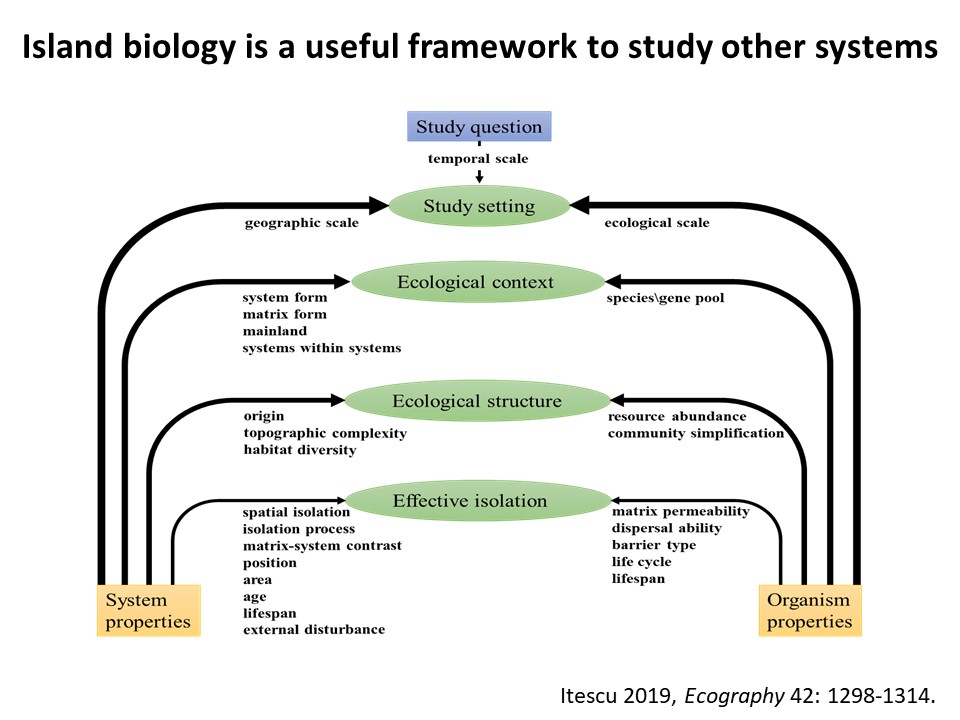
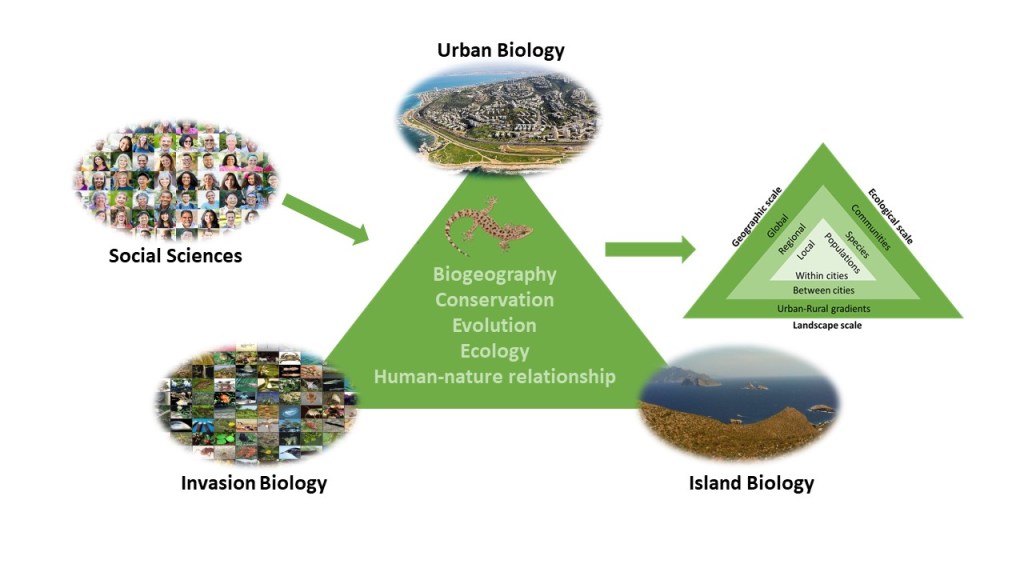
We take a comparative and integrative approach to explore how human activities influence biodiversity and ecosystem dynamics, focusing on the intersection of urban biology, island biology, and invasion biology, and applying island biology principles to study islands, cities, and other island-like systems. Understanding the complex interactions between these anthropogenic impacts is crucial for biodiversity conservation and ecosystem management. However, we cannot draw the full picture without identifying and understanding the human dimensions behind these impacts – diversity, drivers, and relationship with nature – across human societies. By investigating these complexities, across space, time, and taxa, at different scales, we aim to find efficient trajectories to enhance conservation strategies in human-dominated landscapes.
Our research spans four key domains:
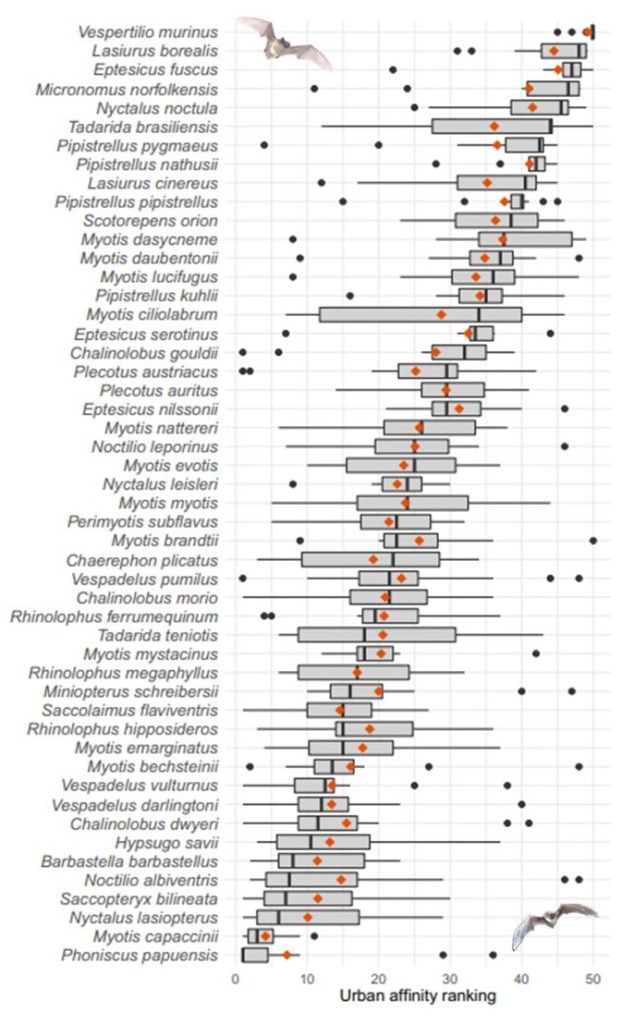
Biogeography: Analyzing factors impacting urban and island biodiversity, including natural and human-induced influences. Through studying biotic assemblages, species’ urban affinity (i.e., the tendency to live in cities), and differential population success, we unravel the characteristics and drivers of urban and insular biodiversity and their conservation implications. We also explore how urbanization and other human activities are affecting natural biogeographic patterns.
Our current work in this context focuses on studying patterns and mechansims shaping urban affinity across species, studying syndromes of life history traits and breeding success in urban and islands populations, and comparing urban and non-urban biodiversity and trait gradients.
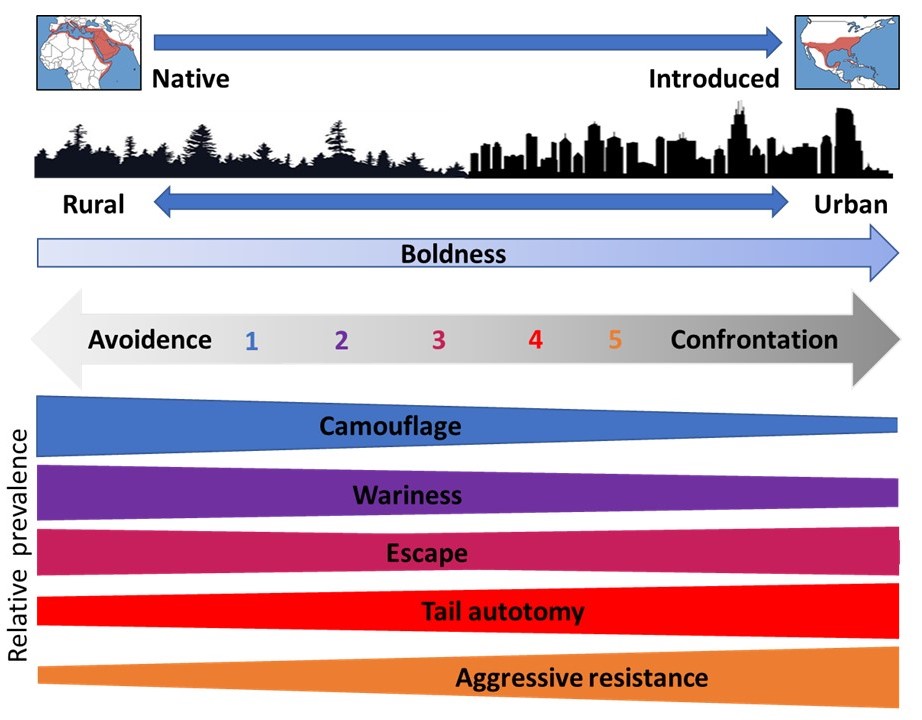
Evolutionary ecology: Investigating species’ evolutionary responses to urbanization, insularity, introduction to novel areas, and climate change, focusing on morphology, life history, and behavior to comprehend adaptive processes shaping biodiversity in human-modified and novel systems.
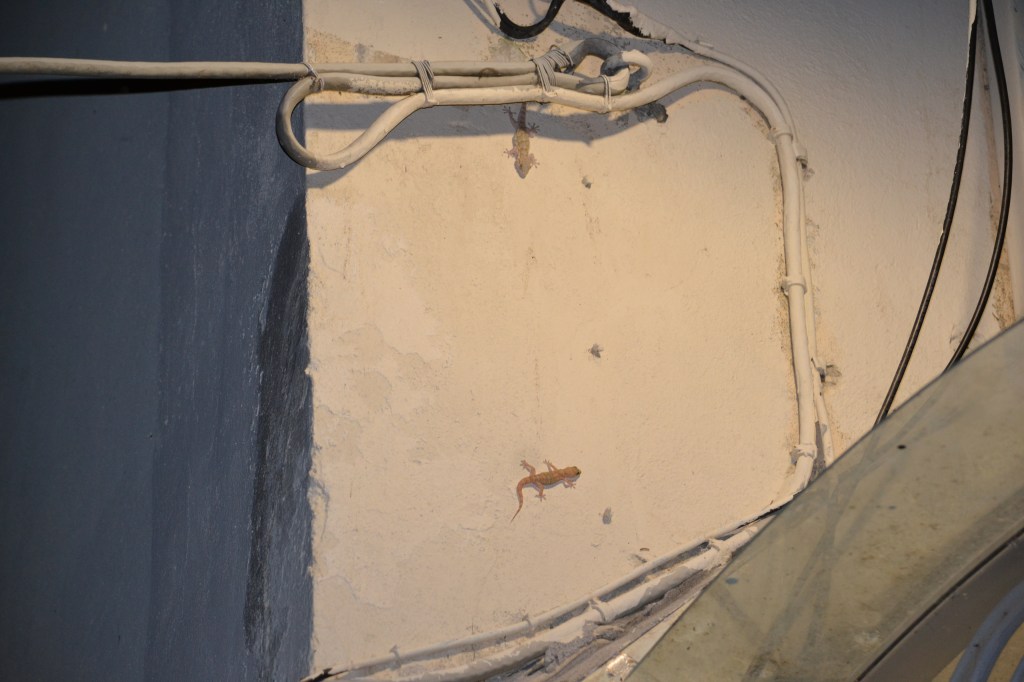
Our current work in this context focuses on the impacts of novel environments on defensive mechanisms of geckos, funded by BSF in collaboration with Kinsey Brock, and on gecko adaptations to microenvironments within cities.
Species Interaction Dynamics: Exploring how human activities such as urbanization and species introductions impact species interactions within ecosystems, and whether the outcomes of these interactions are consistent when repeated under different conditions across space, time, and taxa, illuminating the ecological consequences of human-driven environmental changes.
Our current work in this context focuses on the mechanisms determining outcomes of competition between lizard species.

The Links Between Biodiversity, Anthropologic Diversity, and Human-Nature Relationships: Examining how the diversity of human societies, including aspects such as religious views, cultural traditions, and historical legacies, interplays with biodiversity patterns and human-nature relationship, particularly in urban areas. In this regard, we explore how different stakeholders (e.g., managers, visitors, etc.) perceive, engage with, and even shape nature in different types of urban landscapes such as cemeteries, zoos, and university campuses.
Our current work in this context focuses on biodiverity and ecological functions of cemeteries, in collaboration with Jonathan Jeschke, Tanja Straka, and Christian Voigt.
Other regular collaborators include the labs of Shai Meiri, Panayiotis Pafilis, Johannes Foufopoulos, and Uri Roll.
We ar also members in the CURT initiative, for comparative studies across cities.
 Human Impacts on Biodiversity and Ecosystem Dynamics